



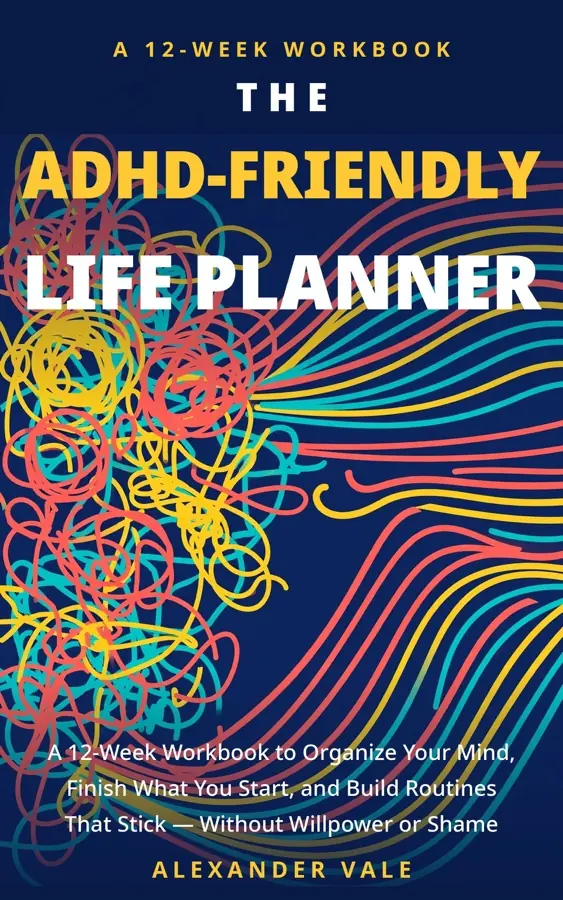
The ADHD-Friendly Life Planner
- Ebook
- Audiobook
$9.99 (ebook)
Released 7 Nov 2026
Listen to the audiobook
About this book
Your brain is not broken. Your planner was. If you have ever bought a beautiful planner, used it for four days, and then felt a wave of shame every time you walked past it — this book was written for you. The ADHD-Friendly Life Planner is a 12-week workbook built for the way an ADHD brain actually works: unreliable activation, invisible time, and motivation that shows up whenever it wants. Instead of demanding more willpower, it teaches you to externalize everything, shrink every start, and design for your worst day — not your best one.
This book was AI-generated and editorially reviewed.
Read an excerpt
From the opening pages of the book.
Let us start with the sentence you may need most in this whole book.
You are not lazy, careless, or broken.
You have probably heard the opposite, sometimes from other people and sometimes from a voice in your own head at 1 a.m. That voice is loud. It is not accurate.
Many adults with ADHD traits describe the same strange experience.
You care about the task. You know it matters. You may even want the result very much. And still, your body will not move toward it.
Then, at the last possible moment, urgency arrives and suddenly you can do in an hour what felt impossible for a week.
That is not a character flaw. That is unreliable activation.
Activation is the moment a thought turns into a first action. For some brains, that bridge is sturdy and automatic. For others, it is there on some days and missing on others, with no clear warning either way.
When activation is unreliable, knowing what to do is not the same as being able to start doing it.
This matters, because most advice assumes the opposite. It assumes that if you just plan better, want it more, or try harder, the action will follow.
If that advice has failed you for years, the problem was the advice, not your effort.
Most planners are designed for brains that work in a very different way.
They assume you will remember to check the planner. They assume a task written down will stay in mind until its time comes. They assume every day will feel roughly the same.
Your experience may be almost the reverse.
If something is out of sight, it can vanish completely, even if it is important. If something is in sight, it can demand attention right now, even if it is trivial.
Ordinary planners also love long, perfect streaks. Miss a day, and the empty boxes stare back at you like evidence. Miss a week, and starting again feels heavier than starting the first time.
So you buy a new planner. For a few days it feels hopeful. Then life gets noisy, the system cracks, and shame does the rest.
This book was built to break that cycle. It expects missed days. It expects messy weeks. Restarting is not a rescue plan here. Restarting is the plan.
There is another pattern worth naming, because it quietly drains so many people.
You miss a deadline or forget something important. Shame rushes in. To escape the shame, you avoid looking at the task, the inbox, or the planner that reminds you of it.