
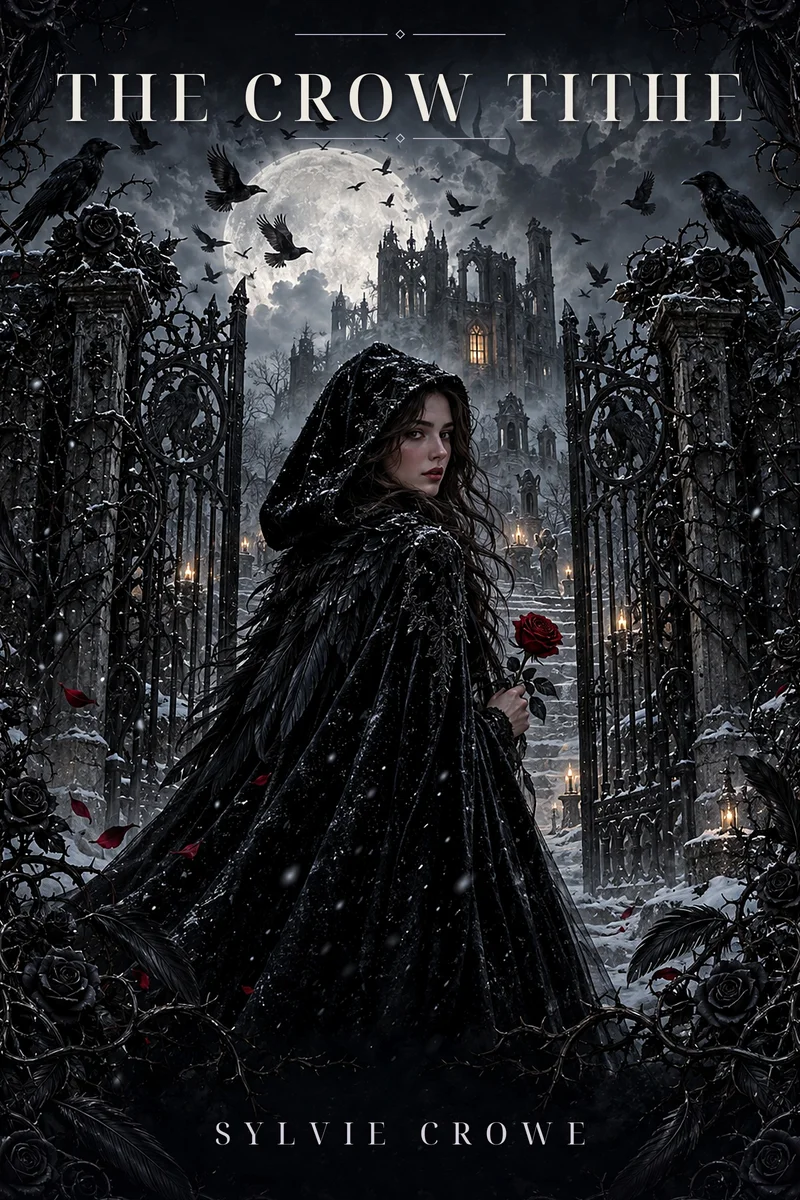


The Crow Tithe
$4.99
Coming 18 Nov 2026
Coming this week
About this book
Every winter, the Thornwood takes a bride. Every spring, the valley buries an empty box. Briar Corvis is the grave-warden of Thornhollow. She has washed and wound and buried the valley's dead since she was fourteen, and she has watched the tithe procession climb the western slope every year of her life. This year, the choosing bell rings her name. What waits in the wood is not the monster of the chapel tales. Silas Greve has kept Crowholt for three hundred years: a manor of black roses and candle-keepers, a ledger of borrowed names, and a covenant stitched into the valley's founding that feeds the wood a bride each winter to keep a buried god asleep. The tithe was never a marriage. It was a payment. And payments, as any grave-warden knows, always come due. With the Longest Night approaching and the god under the hill beginning to stir, Briar must decide what she owes the dead, what the living owe each other, and whether the fraying, courteous, three-hundred-year-old man behind the covenant deserves the freedom nobody ever thought to offer him. Breaking the tithe will take a box of relics, the true names of the dead, a bell-ringer's silence, and one very opinionated crow. A complete standalone gothic romantasy about names, debts, and chosen vows, with a slow-burn closed-door romance, a dark fairy-tale wood, and a hopeful ending.
This book was AI-generated and editorially reviewed.
Read an excerpt
From Chapter 1 — the opening of the book.
The dead get talkative before the Longest Night. Most years it is a murmur, like a wind that has opinions. This year, more than three weeks out from the solstice, it was already a choir.
“Quiet,” I told them, and pressed the cloth to old Toma’s brow.
The dead do not obey, exactly. But I have a voice they listen to, the way sheep listen to a dog they respect, and the murmuring thinned to a thread. I washed Toma the way my mother taught me, and her mother taught her, top to bottom, left to right, warm water first and cold water last. He had been the village tanner for forty years and his hands still smelled faintly of oak bark under the lye. His ghost stood at the foot of the table and watched me work with his arms folded, the way he used to watch the apprentices.
“You missed behind the ears,” Toma said.
“I did not.”
“Behind the left ear.”
I went over the left ear again without arguing. The dead are vain about the strangest things. He was my third this month, which was two more than a November usually gives us, and the frost on the wash-house windows was ferned so thick the morning light came through green.
“Is it true what they’re saying below?” I asked him.
The dead hear more than the living. They hear the hill.
Toma’s ghost looked at the floor, which is what ghosts do instead of lying. “You should oil the hinges on the gate,” he said. “Before the choosing. Nothing looks worse than a screaming gate at a wedding.”
“Toma.”
“I buried three winters of girls, Briar. I don’t have opinions on it anymore.” He faded the way they do when they have decided the conversation is over, going thin from the edges inward, like a breath off glass. “Behind the ears,” he said, from nowhere, and was gone.
I finished alone, and wound him in good linen, and sewed the shroud with the small even stitches my grandmother used to say were the last gift anyone gives anyone. Outside, the cemetery glittered. Frost on every stone, frost on the iron ribs of the gate, frost feathering the bare briars of the hedge that gave the village half its name. Thornhollow. The other half is the valley itself, cupped in its ring of white ridges like an egg in a fist, with the Thornwood standing black against the western slope and, at the wood’s heart, the hill.
Tropes
- Tithe bride
- Slow burn
- Closed-door romance
- Cursed forest
- Death god
- Immortal hero