



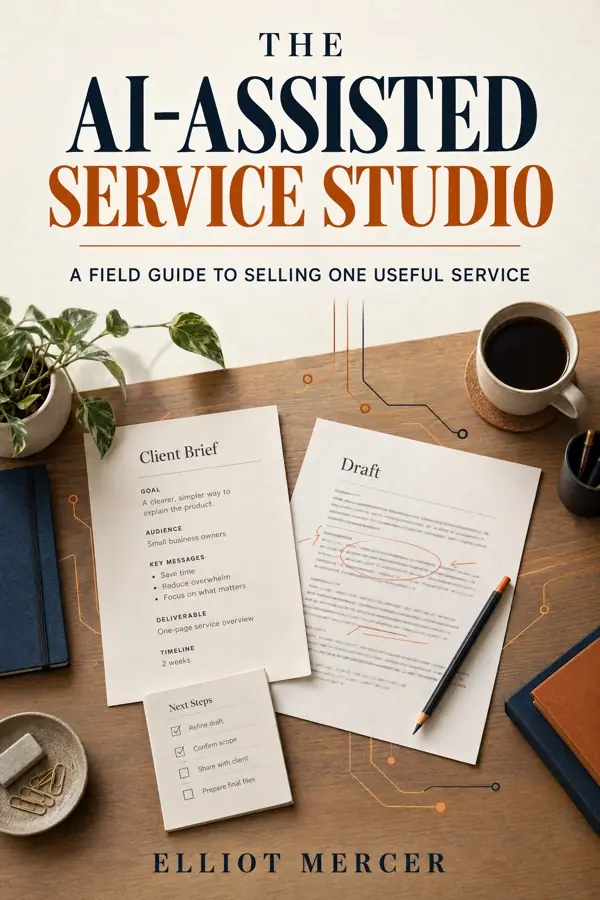
The AI-Assisted Service Studio
- Ebook
- Audiobook
$9.99 (ebook)
Released 6 Nov 2026
Listen to the audiobook
About this book
The AI-Assisted Service Studio is a practical field guide to selling one useful service. Instead of chasing every AI side hustle, you build one service for one kind of client — a clear deliverable, a fair price, and a process you can inspect. Across 15 chapters, Elliot Mercer walks through choosing a narrow service, finding clients with an expensive annoyance, defining the deliverable, pricing the work, building proof before testimonials, running projects clients can trust, and turning good work into repeatable operations. With a practical toolkit and a 90-day scorecard to guide the first three months. All examples are fictional teaching scenarios.
This book was AI-generated and editorially reviewed.
Read an excerpt
From Introduction: one useful service — the opening of the book.
An AI tool can produce a page of copy before you finish your coffee. That speed is real. It can also distract you from the harder question: what should a client trust you to deliver?
This book takes a narrower path than the usual tour of AI side hustles. You will build one service for one kind of client, then learn to make the work clear, useful, and repeatable. The tool can help with research, drafts, analysis, formatting, and routine transformations. You remain responsible for what goes to the client.
A service studio does not need an office, a team, or an elaborate brand. It needs a problem that a particular client recognizes, a result you can describe, a process you can inspect, and a boundary around what you are willing to promise. It also needs a way to find out whether your offer is useful before you invest months polishing it.
The examples in these pages follow fictional people. Mara Voss is a careful solo operator who helps small firms turn rough material into clear client-facing documents. Theo Bennett runs a fictional professional-services business. Sofia Marin operates a fictional small online shop. Niall Price is a fictional designer, and Elena Ward is a fictional bookkeeper. Their choices are teaching examples, not proof of results.
You do not need to adopt Mara's service. The point is to see the decisions underneath it. The same questions apply whether you work with documents, product information, customer support materials, research summaries, or another task that benefits from careful human review.
A small first version is enough. It should be clear enough to discuss with a real prospective client, bounded enough to estimate, and safe enough to deliver without pretending an AI system is infallible. Then you can learn from actual conversations and work, not from a fantasy spreadsheet of future revenue.
A service offer starts with a person who has a problem worth solving. The prompt comes later.
That order matters because an AI tool can produce words, images, outlines, code, or summaries on command. It cannot decide, by itself, whose afternoon is being wasted, what a client is afraid of getting wrong, or what a finished piece of work must allow someone to do. If you begin with a prompt, you can end up selling activity: "I use AI to create content." A client usually needs an outcome they can recognize: a set of product descriptions that follows their house style, a cleaned-up onboarding guide, or a weekly report that a busy manager can actually read.