



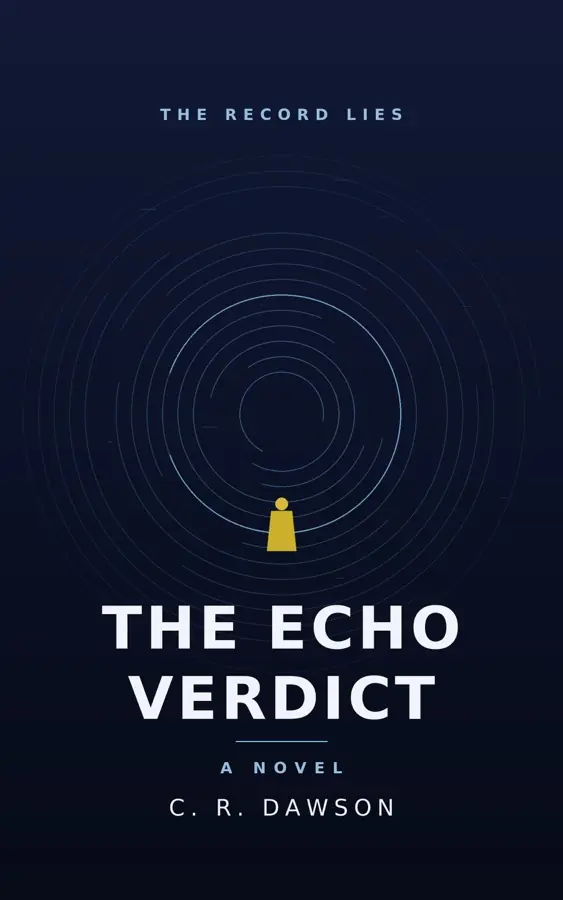
The Echo Verdict
- Ebook
- Paperback
- Audiobook
$4.99 (ebook)
Released 6 Nov 2026
Listen to the audiobook
About this book
In 2047, the courts run on recovered memory. A scan does not lie, a certification cannot be forged, and Nora Vance, senior memory auditor, has signed her name to four hundred and eleven of them. Then a routine confirmation audit lands on her desk: Elias Ward, the Halden Row bomber, two hundred and fourteen dead, convicted by his own memory - a memory Nora finds a flaw in. Inside the condemned man's reconstruction stands a little girl in a yellow raincoat who should not exist. She is nine years old. She is not looking at the bomber. She is looking at the auditor. And she is Nora. The deeper Nora pulls the thread, the more of her own life comes with it: an anchor vault with her rewritten childhood, a mother who died twenty-seven years ago and did not, a signal humming under the floors of the Fidelity tower, and a secret council that decides - for everyone - what true means. To free an innocent man, Nora will have to do the one thing the system was built to prevent: wake the sleeper the system is built on, and let the record testify against its keepers.
This book was AI-generated and editorially reviewed.
Read an excerpt
From Prologue — the opening of the book.
The memory arrives the way all of them do: without permission.
He is standing on the service walkway above Halden Row station, and the air tastes of ozone and rain. Below him the concourse moves in its evening patterns, commuters flowing toward the maglev platforms in rivers of grey and navy wool, children dragged along by the hand, a violinist sawing at something old near the ticket gates. He knows what he is carrying. The bag is heavy against his hip, heavier than its contents should be, the way objects are in dreams, and he thinks: this is the last thing I will ever do as a free man. The thought does not feel like his. It sits in his head like a coin under the tongue, foreign and cold.
He checks his watch. 18:41. The 18:47 to Dunmore is boarding on platform three, and the concourse loudspeaker is reciting destinations in its flat, patient voice, and somewhere underneath the loudspeaker there is another sound, a wrongness he has never been able to name, a thin tone like a wire pulled tight.
He descends the maintenance stairs. His hands are steady. That is the detail the prosecutors love: his hands are steady, his breathing is slow, he moves through the crowd like a man who has rehearsed, because he has rehearsed, the memory says so, the memory shows him rehearsing in a rented room above a laundromat in the Kestrel district, laying the components out on a sheet of brown paper with the care of a surgeon.
Platform three. The maglev waits with its doors open, sleek and white and humming. Two hundred and fourteen people will board it or stand near it in the next six minutes. He places the bag beneath the bench at the platform’s northern end, tucks it against the bench leg with his foot, a casual motion, a forgotten-luggage motion, and he turns away, and he walks, and he does not run, because men who run are remembered.
And that is when he sees the girl.
She is standing by the vending machines at the end of the platform, alone, maybe nine years old, in a yellow raincoat too bright for the grey evening. She is watching him. Not the way a child watches a stranger, idly, the gaze already sliding elsewhere. She is watching him the way you watch someone you recognize and cannot place, her head tilted slightly, her dark hair damp from the rain she must have walked through to get here, and her eyes, her eyes are the wrong thing, the thing he has never told the court psychologists, the thing that wakes him at three in the morning in his cell, because her eyes are not afraid, and they are not curious. Her eyes are sorry for him.