


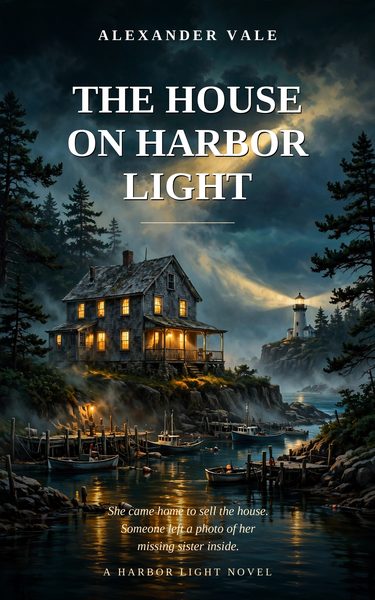
The House on Harbor Light
- Ebook
- Audiobook
$2.99 (ebook)
Released 8 Nov 2026
Listen to the audiobook
About this book
She came home to sell the house. Someone left a photo of her missing sister inside. Fifteen years ago, sixteen-year-old Wren Harlow vanished on festival night in Harbor Light, Maine — and the town decided she ran away. Her sister June believed it too, until she came back to sell their grandmother's house and found a photograph hidden in the kitchen: Wren at the lighthouse point, the day before she disappeared. June is a scientist. She does not believe in ghosts, and she does not believe in easy stories. With Detective Jonah Hale — the boy who once accused her family in front of the whole town — she starts pulling at the threads: a bracelet with no chain of custody, a backpack on a bus route no bus ever ran, a lighthouse log with a truck at the point at 10:35 p.m., and a ledger page that names what the town was paid to forget. Told across two timelines — June's present-day investigation and Wren's last summer, in her own voice — The House on Harbor Light is a psychological romantic suspense about a family, a town, and the price of fifteen years of silence. The mystery is fully resolved, the killer faces justice, and the ending is hopeful. Book 1 in the Harbor Light series.
This book was AI-generated and editorially reviewed.
Read an excerpt
From Chapter One — the opening of the book.
The ferry horn sounded twice before the boat cleared the fog, and June Harlow stood at the rail with salt on her lips and fifteen years of careful distance coming apart under her hands.
She had told herself she would not come back by water. The drive from Boston took five hours, and the last forty minutes wound through pine and granite and towns that sold lobster rolls to people who had never gutted a fish. She had taken the ferry anyway, at the last turn, because the road into Harbor Light had always ended at the dock, and because some part of her wanted to see the town the way she had left it: from the water, with the lighthouse standing white against the sky and the harbor spread out below it like a held breath.
The lighthouse stood where it had always stood, on the point beyond the breakwater, its paint peeling at the base and its lamp dark. It had been decommissioned before June was born, a handsome white tower with no work left to do, and the town kept it the way people keep a photograph of someone they have lost: polished, pointed at, never quite touched.
June gripped the rail. The wind pulled strands of dark hair loose from her braid and whipped them across her face. She tucked them back with one hand and kept the other on the rail, her knuckles white, her field jacket zipped to her chin though the morning was warm. A gull screamed overhead. The smell hit her then, all at once — low tide and diesel and wet rope and the sharp green scent of the marsh at the harbor's edge — and her throat closed.
She had spent the last decade learning the names for things. Plankton blooms and tidal ranges and the way a coastline changed when the water warmed by half a degree. She could stand on a research vessel in a storm and call out readings in a steady voice. She could not stand on this ferry and name what the smell of home did to her chest.
The ferry bumped against the dock. Men in oilskins caught the lines. A boy in a Harbor Café apron carried a crate of bread toward the café door. June watched him and thought of mornings when she had run down this same dock with a backpack bouncing against her spine, late for the school bus, her sister shouting behind her to wait.