


The Teashop of Small Magics
- Ebook
- Audiobook
$3.99 (ebook)
Released 9 Nov 2026
Listen to the audiobook
About this book
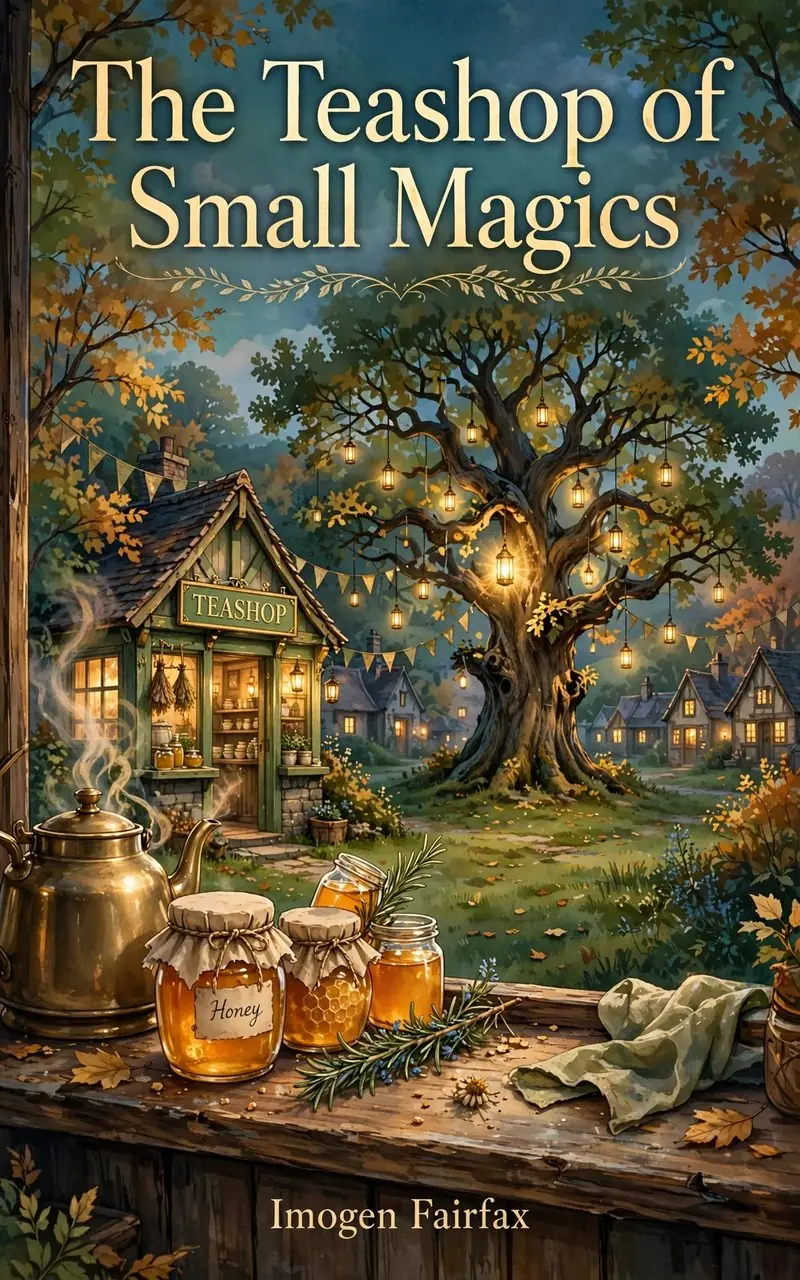
Wren Halloway came to Bramblewick to sell her grandmother's teashop. She stayed because of a talking kettle, a garden that grows exactly what the shop needs, and letters that deliver themselves to people who truly need tea. But the village's Lantern Tree has been dark for three years, the Harvest Lights Festival is about to be replaced by a modern market fair, and the councillor behind the plan is grieving a loss he will not name. To save the tree, Wren will have to gather the village's memories — seven small stories, one shared pot of tea — and pour them at the roots at dusk, in front of everyone. A warm, witty cozy fantasy about found family, second chances, and the small magic of a good cup of tea, with a slow-burn romance, a beekeeper with a bee on his shoulder, and a kettle with opinions.
This book was AI-generated and editorially reviewed.
Read an excerpt
From Chapter 1: Arrival — the opening of the book.
The coach from Aldermere stopped at the edge of Bramblewick at half past three on a Saturday afternoon, and Wren Halloway stepped down into a village that smelled of woodsmoke and cut hay.
She had been awake since five, and she had eaten one cold roll on the coach and wished for a second. Her carpetbag held the deed, the brass key, a shawl, and a packet of ginger biscuits she would not share with anyone.
"That'll be the Gilded Kettle," the driver said, nodding toward the green. "East side. The one with the sign like a teapot."
Wren looked. The village green was a wide sweep of grass, gold-tipped after a dry summer, with a great tree at its center. The tree was huge and old, its branches spreading wide, and hanging from them were dozens of small glass lanterns, dark and empty. She had never seen a tree wear lanterns before. She decided she liked it.
Beyond the green, the teashop stood waiting: two stories of honey-colored stone, a shopfront window gone grey with dust, and a sign above the door, hanging at a slight tilt, painted gold in the shape of a kettle. Underneath it, in letters worn thin by weather: THE GILDED KETTLE.
Her grandmother had owned this shop for fifty years. Wren had visited twice as a child, and remembered honey on toast, her grandmother's laugh, and being allowed to stir the honey into her tea herself.
Her grandmother had died the previous winter. The shop had stood empty for months. Now the key was in Wren's pocket, heavy as a small stone, and there was no one left to ask what she was supposed to do next.
She paid the driver and dragged her trunk across the green, the wheels catching on a tree root, and pretended this was exactly how she had planned to arrive.
The lock was stiff; the key turned with a grind, and the door swung inward. The smell of the shop came out to meet her: dust, old tea leaves, beeswax, and something green and sharp that might have been mint, gone wild behind a wall somewhere.
"Hello," Wren said to the empty shop. Her voice sounded too loud, so she said it again, softer. "Hello, shop."
The shop did not answer. The shop was a shop. Wren told herself this firmly and set her trunk down by the counter.