
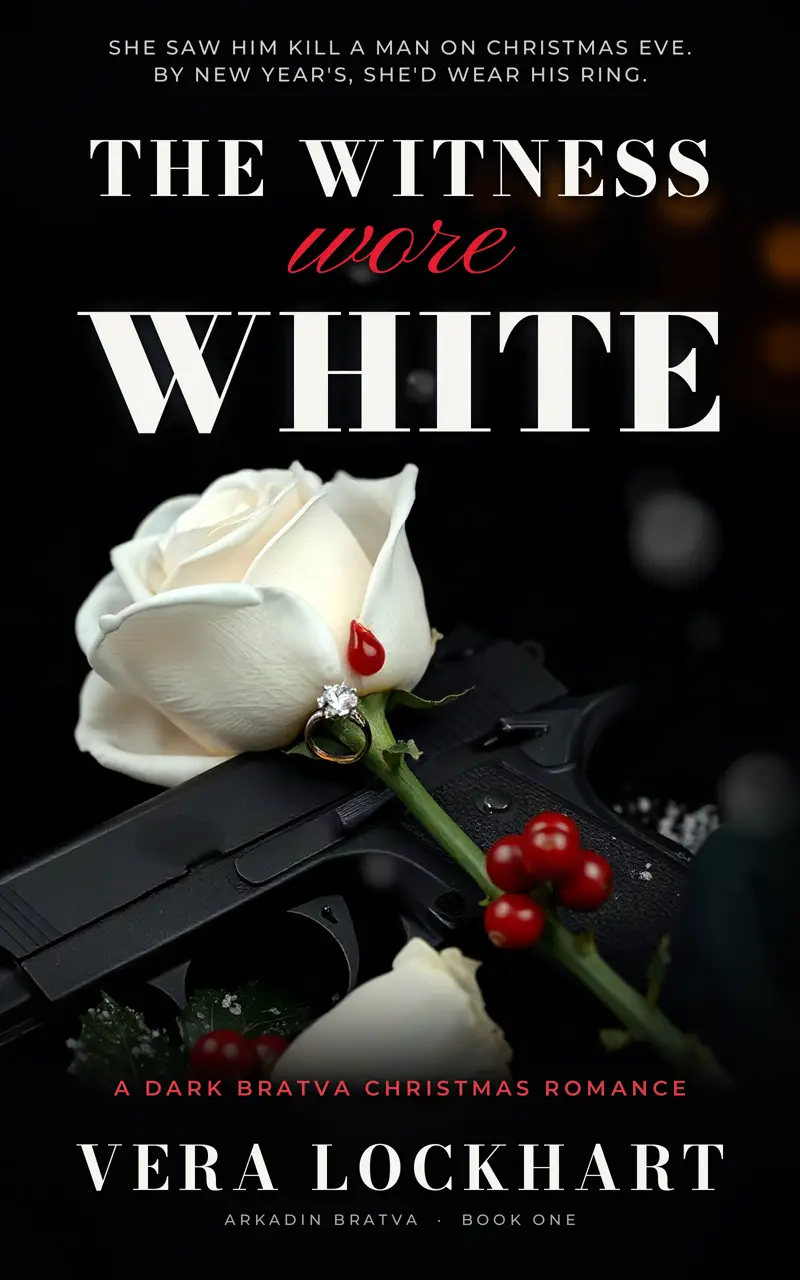
The Witness Wore White
- Ebook
- Audiobook
$2.99 (ebook)
Released 10 Nov 2026
Listen to the audiobook
About this book
She saw him kill a man on Christmas Eve. By New Year's, she'd wear his ring. Pianist Clara Bishop goes back to the old Larkspur Theatre for one thing: her late mother's Nutcracker score. Instead, under the ghost light and the stage's towering Christmas tree, she watches Lev Arkadin, the ice-cold head of Chicago's Arkadin Bratva, put a bullet in a traitor. Bratva rules say a witness doesn't leave the building. Lev has a better idea. A wife can't be forced to testify against her husband. So he proposes. She says yes, because the alternative is a grave.
This book was AI-generated and editorially reviewed.
Read an excerpt
From CHAPTER ONE — the opening of the book.
Clara
The last time I saw a man die, I was holding my mother's handwriting against my chest like it could stop a bullet.
Nobody tells you that a gunshot in an empty theater doesn't end. The Larkspur was built in 1911 to carry a soprano to the back of the second balcony, and it carried this too: one flat crack, then the long silver ring of it rolling up through the fly loft and into the gold-leaf angels on the ceiling, where it hung for a while, as if the building wanted to hear it twice.
But that was later. That was 11:58 p.m.
At 7:00 p.m. on Christmas Eve, the worst thing in my life was a nine-year-old snowflake named Priya who had lost a tooth in the wings and was bleeding, delicately, on her tutu.
"It's festive," I told her, crouched on the stage-left floor with a wad of tissue. "Red and white. You're a candy cane now."
"Miss Odile will kill me."
"Odile Varga has killed no one in seventy-two years. She's saving it for something big."
Priya laughed through the tissue, which was the point. Out front, four hundred parents rustled programs and coughed the specific cough of people who have been told to silence their phones. The Larkspur smelled the way it always did in December: sawdust from the restoration crews, old velvet, hot radiator dust, pine.
The tree was the reason half the audience had bought tickets. The Act I set was a painted parlor, a little shabby up close, but center stage stood a real fir, eighteen feet of it, wired with warm white lights and hung with glass ornaments some long-dead prop master had bought in Prague. When the house went dark and it lit up, every child in the theater made the same sound. So did I, every night, for nine performances.
I was at piano one. The Larkspur's orchestra pit had been gutted for new floorboards, so Miss Odile's production ran on a two-piano reduction and two pianos parked in the stage-left wing, angled toward the dancers like a pair of elderly chaperones. Marcus, a friend of my best friend Junie, played piano two. Marcus counted under his breath and chewed cinnamon gum so hard I could hear it through the overture.
My mother's score sat open on my music stand. Tchaikovsky's Nutcracker, arranged for two pianos, the cover soft as cloth from handling, every page crowded with her pencil. Fingerings. Arrows. A tiny drawn snowflake over the Waltz of the Snowflakes. And there, at the top of the Act I finale, in her slanting church-organist hand: breathe here, Clary.